
Product Design / UIUX Project

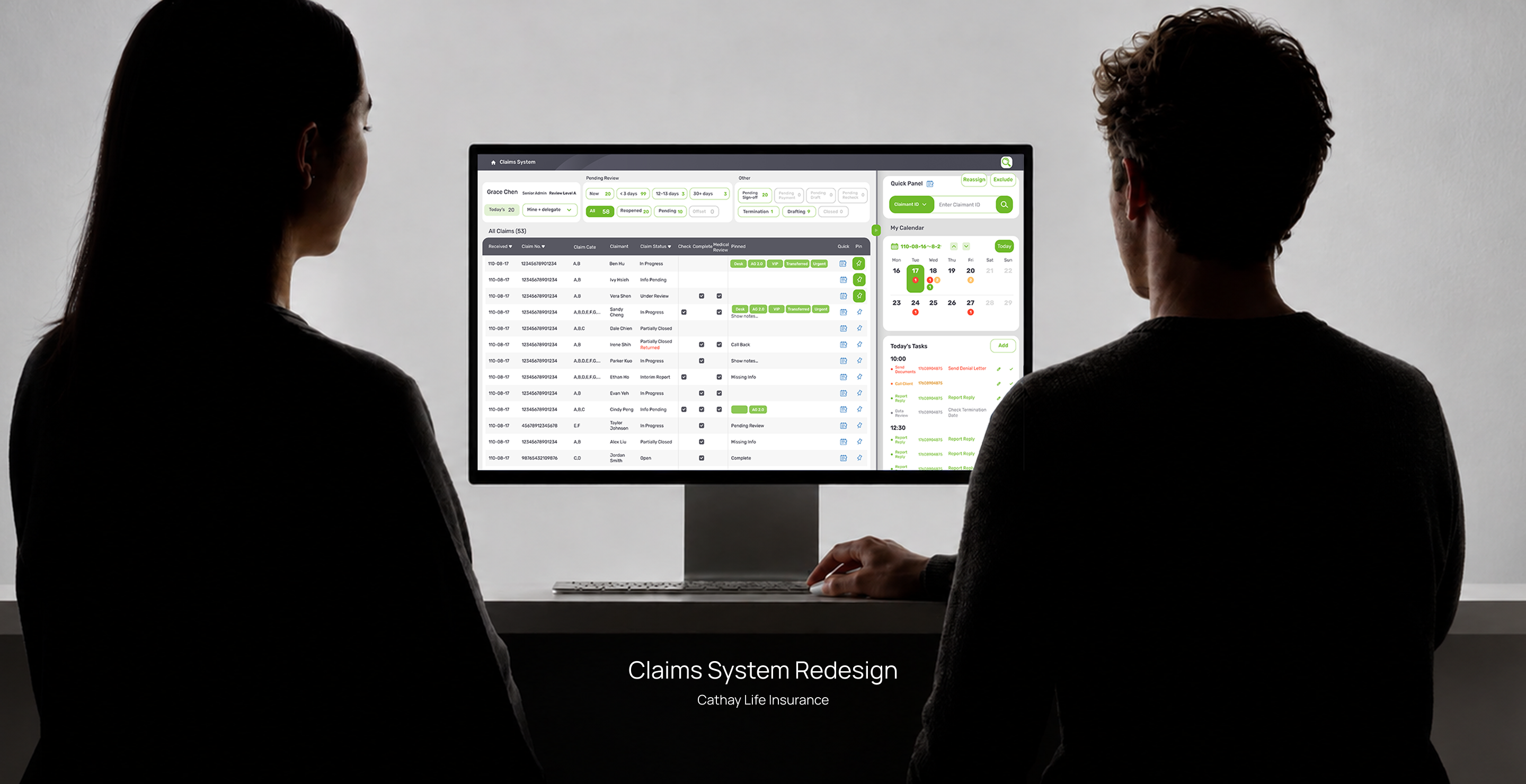
Claims System Redesign

Cathay Life Insurance

Project Overview

The claims system is one of Cathay Life Insurance’s core internal tools and supports the daily work of claims specialists. The legacy system had been in use for more than 10 years, with new requirements layered onto its existing structure as insurance products changed. Working with the client product team, we reviewed workflows, interfaces, and features. Interviews and usability testing helped us understand how specialists worked, where the system slowed them down, and what they needed from the redesign. The goal was to make the system a practical day-to-day assistant and a single place for claims work.

Project Information

Client
Cathay Life Insurance
Year
2021–2022
Role
UX Designer & UX Researcher
Delivery
Web (19-inch desktop)
Team
UI Designer, Research Support
System scale
400+ users
Claims System Redesign overview

Claims System Redesign | Contributions

Planned a redesign for a large insurance operations tool serving 400+ users, connecting day-to-day claims work with product goals.

  1. 1Planned user research and led 4 stakeholder interviews and 5 user interviews.
  2. 2Analyzed qualitative findings, produced a research report, and worked with stakeholders to set the redesign direction.
  3. 3Planned workflow and interface improvements across the legacy system’s six functional areas.
  4. 4Planned 6 formative usability tests and interviews, coordinated analysis, and produced a research findings report.
Julia Chen

Stakeholder and User Interviews

The claims system spans multiple departments, regional offices across Taiwan, and all claims staff. To align the redesign direction and support smoother design and development collaboration, we worked with the client team on stakeholder interviews and user interviews with claims specialists. These conversations clarified goals across roles and how the current system was used.

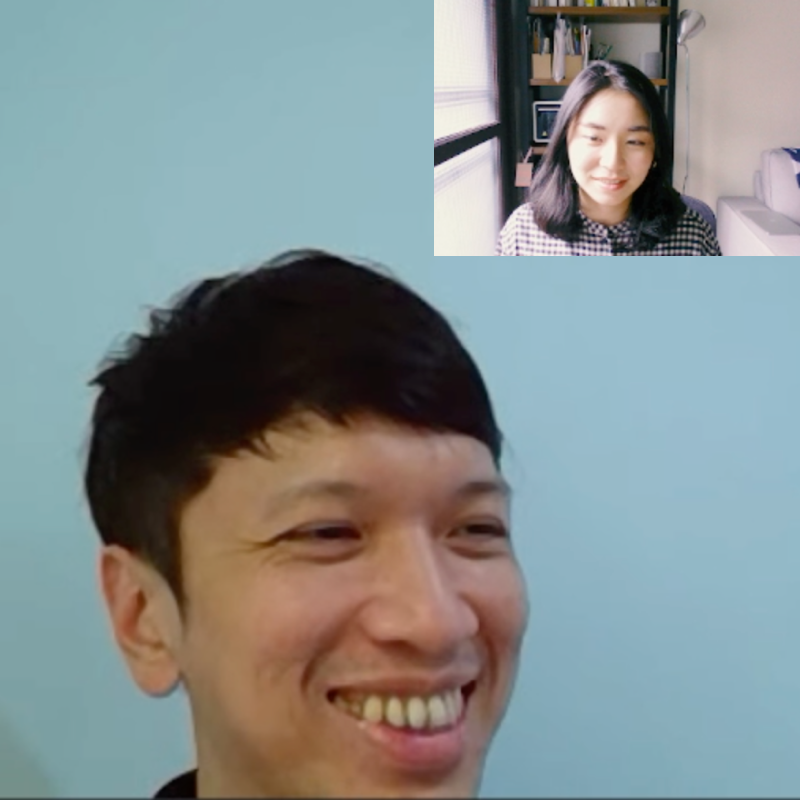
Stakeholder interview

Stakeholder Interviews

Stakeholder interviews clarified role relationships, areas of impact, and expectations from the Cathay Life Insurance product team. We used four focus areas to clarify product goals and build shared understanding.

  1. 1

    Primary product expectations

  2. 2

    Measures of product effectiveness

  3. 3

    Operating procedures and areas of product impact

  4. 4

    Stages affected by stakeholder interests

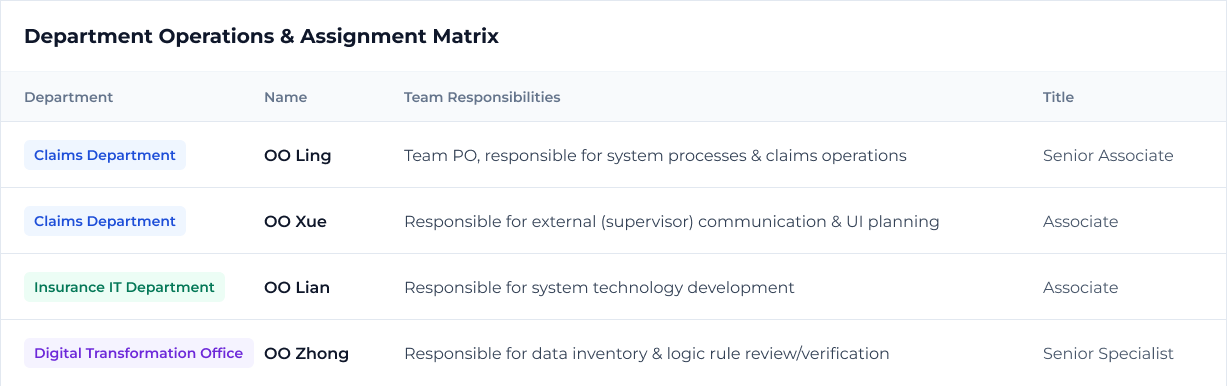
We held one-on-one interviews with roles influencing different parts of the product. They deepened our understanding of each role’s work and supported the redesign kickoff and ongoing collaboration.

Stakeholder participant profile
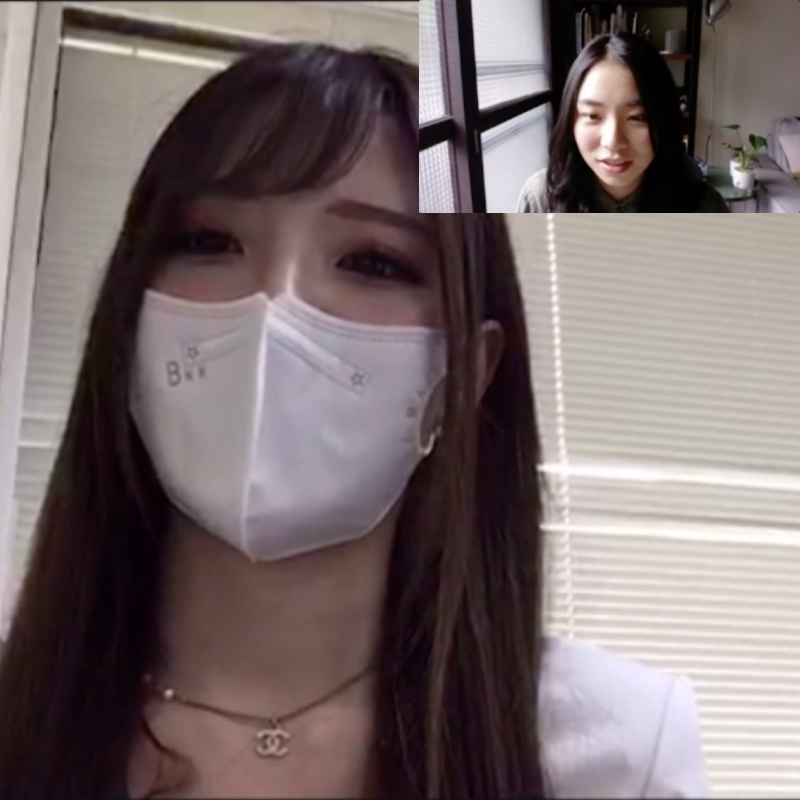
User interview

User Interviews

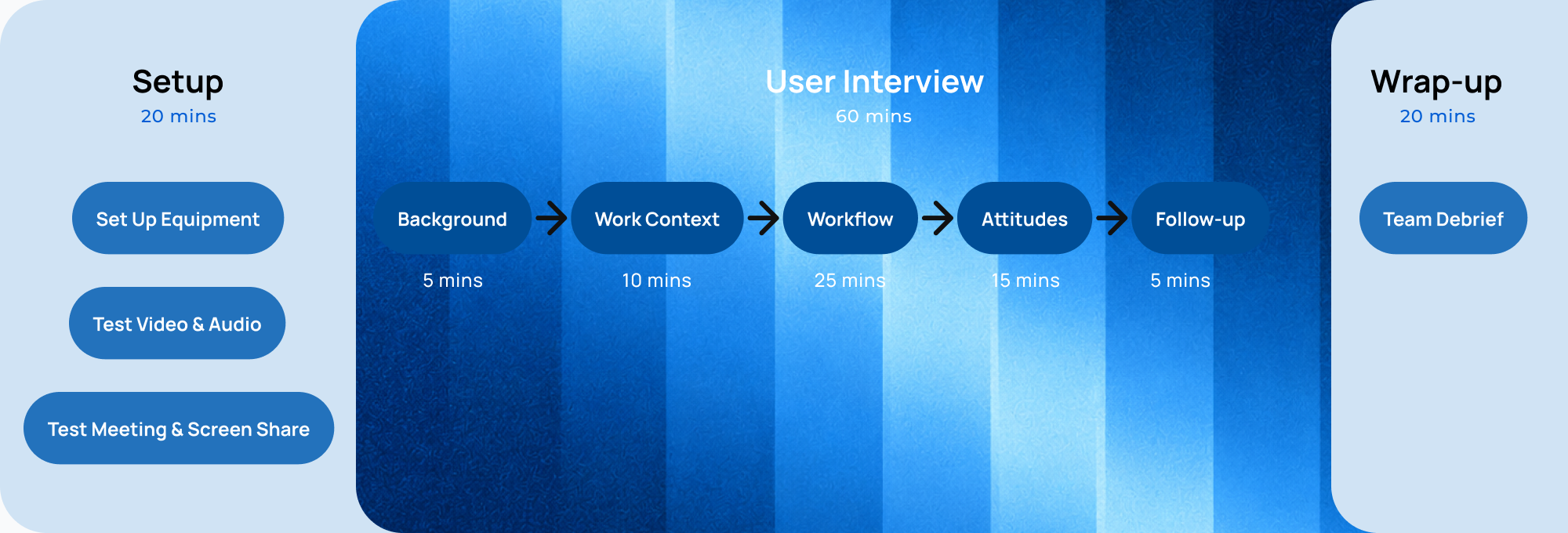
User interviews with claims specialists helped us understand detailed workflows and reactions to the system. The interviews focused on system experience, redesign direction, and expectations for key features. We interviewed 5 users and screened participants across three dimensions to test assumptions about their working contexts.

  1. 1

    Role and tenure Assessed whether case complexity and tenure affected workflows and learnability.

  2. 2

    Department Examined whether different departments led to different work habits or workflows.

  3. 3

    Age Reviewed adaptation to system interactions and work habits.

Read the Claims System User Research

Problem Definition

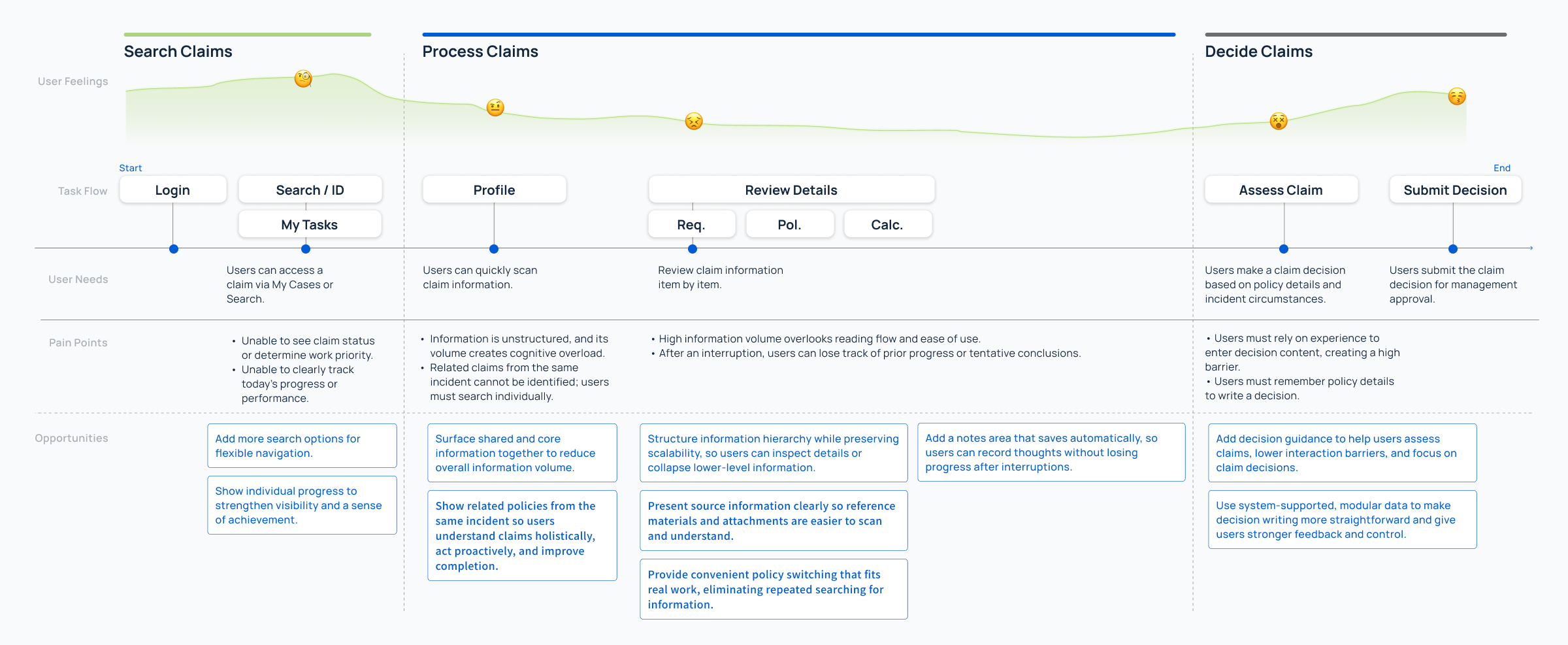
We turned interview findings into a journey map to identify situations and pain points claims specialists might encounter, then used design experience to identify practical opportunities for improvement.

Claims specialist journey map
  1. 1

    Information Organization & Usability

    Organize related information and make dense screens easier to read.

  2. 2

    Workflow Optimization & Guided Actions

    Guide people through complex workflows and lower the learning curve.

  3. 3

    Personalized Content

    Support different working habits with a more adaptable workspace.

Interview research process from stakeholder and user interviews to design direction

Design Challenges

Mapping Complex Product Architecture and Content

Claim review is the core work of claims specialists and involves repeated, complex tasks: reviewing documents and hospital receipts, validating amounts, and checking beneficiary payment ratios. Different policy products have different claim categories and payment methods, which makes system data and workflows complex. We used user flows to review case workflows with the client and clarify specialized terms, helping the team build a shared understanding of the product.
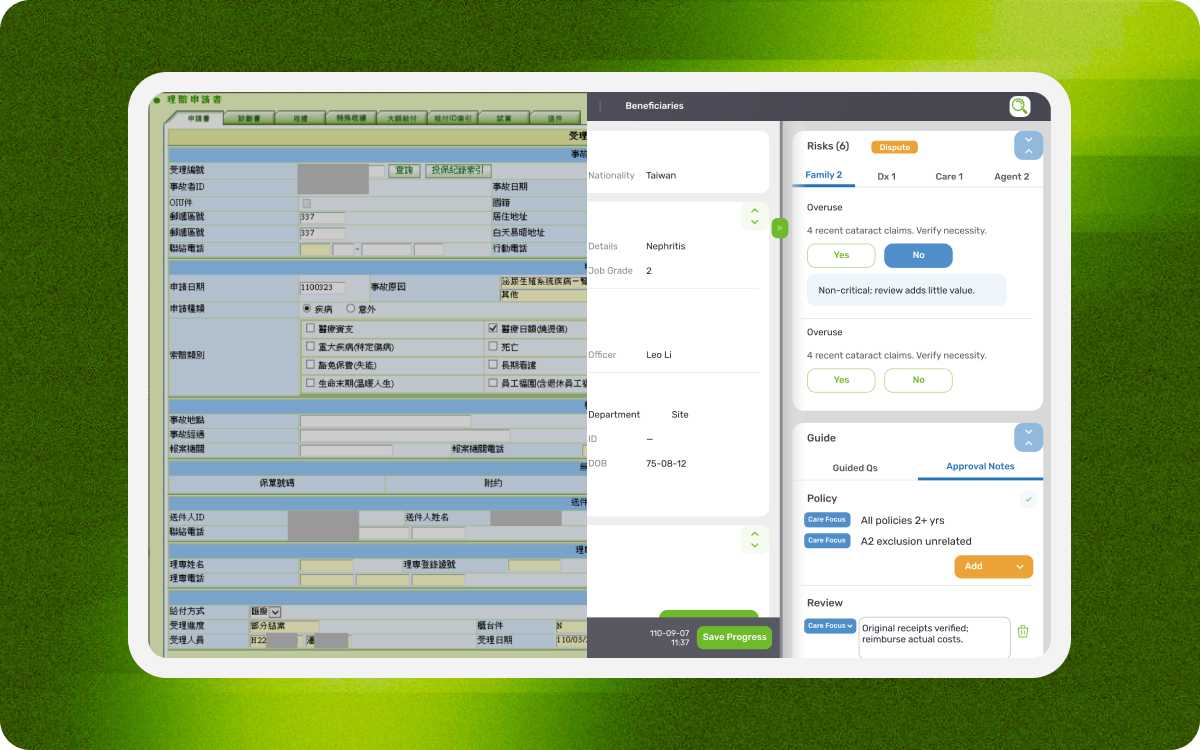
Comparison of legacy and redesigned claims-system interfaces and information architecture
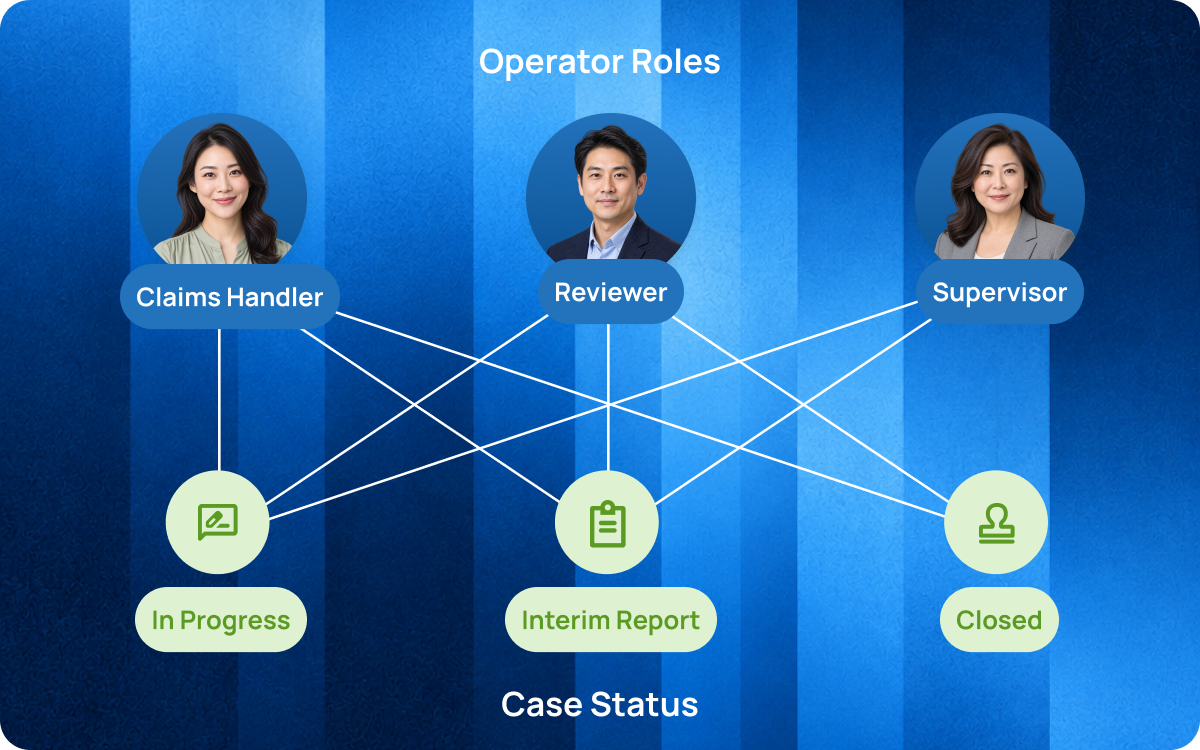
Workflow showing the relationship between role permissions and claim states

Accounting for Roles, Permissions, and Case States

Different role permissions and claim states create many combinations. The team needed to clarify industry knowledge, product rules, permissions, and workflow logic, then check how each case should be handled in every state.

Documenting Decisions for Design and Engineering

Members of the product team had different levels of familiarity with digital products. For each new feature, I documented the design rationale, control states, and interaction logic so the team could discuss the same behavior. I also prepared engineering specifications that described interface functions and control logic before implementation.

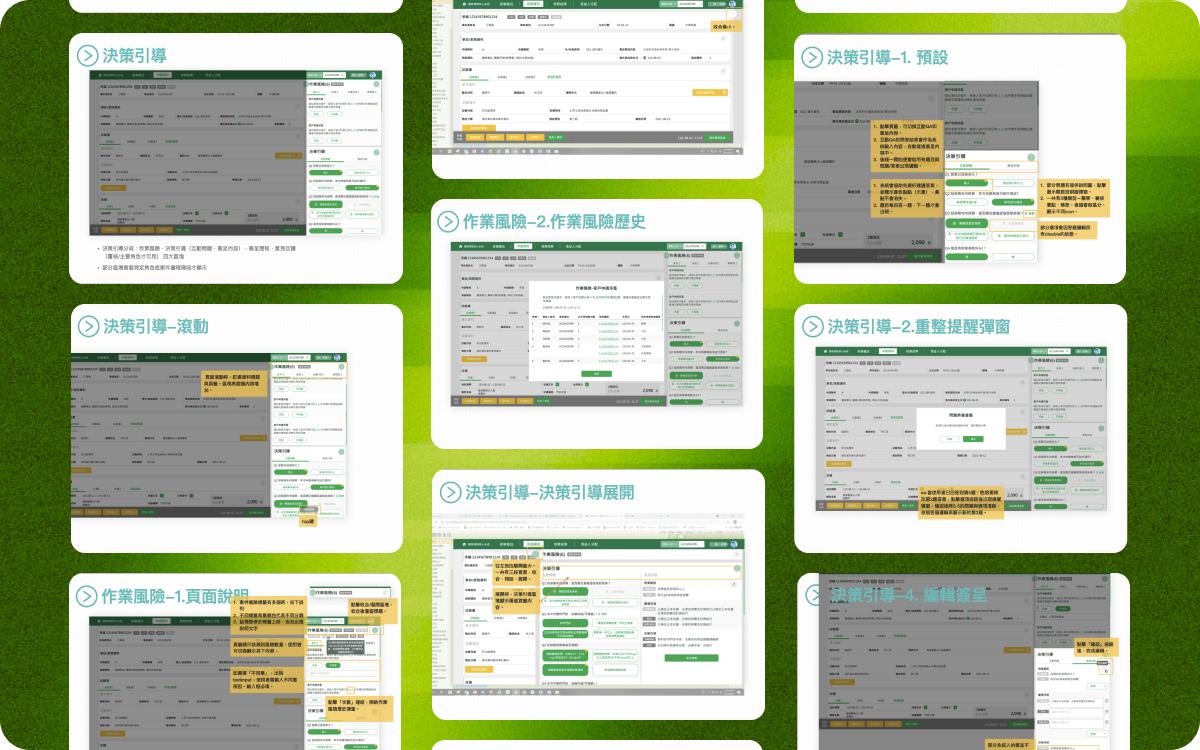
Design communication documents and engineering specifications

Product Architecture

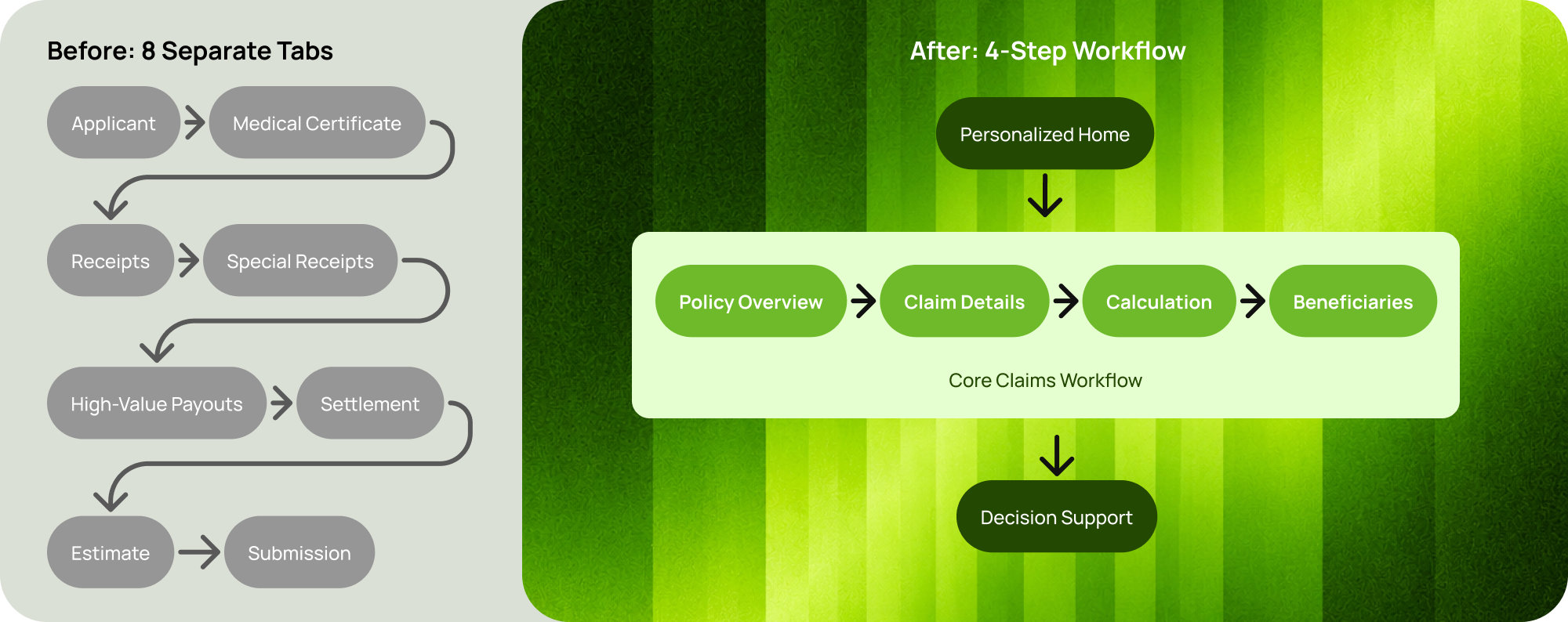
We broke down the many existing system screens, clarified the purpose and flow of each, and reorganized the original 8-step claim-review process into four stages: Policy Overview, Claim Details, Calculation, and Beneficiaries.

Claims product architecture reorganized from 8 steps into 4 stages

Design Solutions

Information Organization & Usability

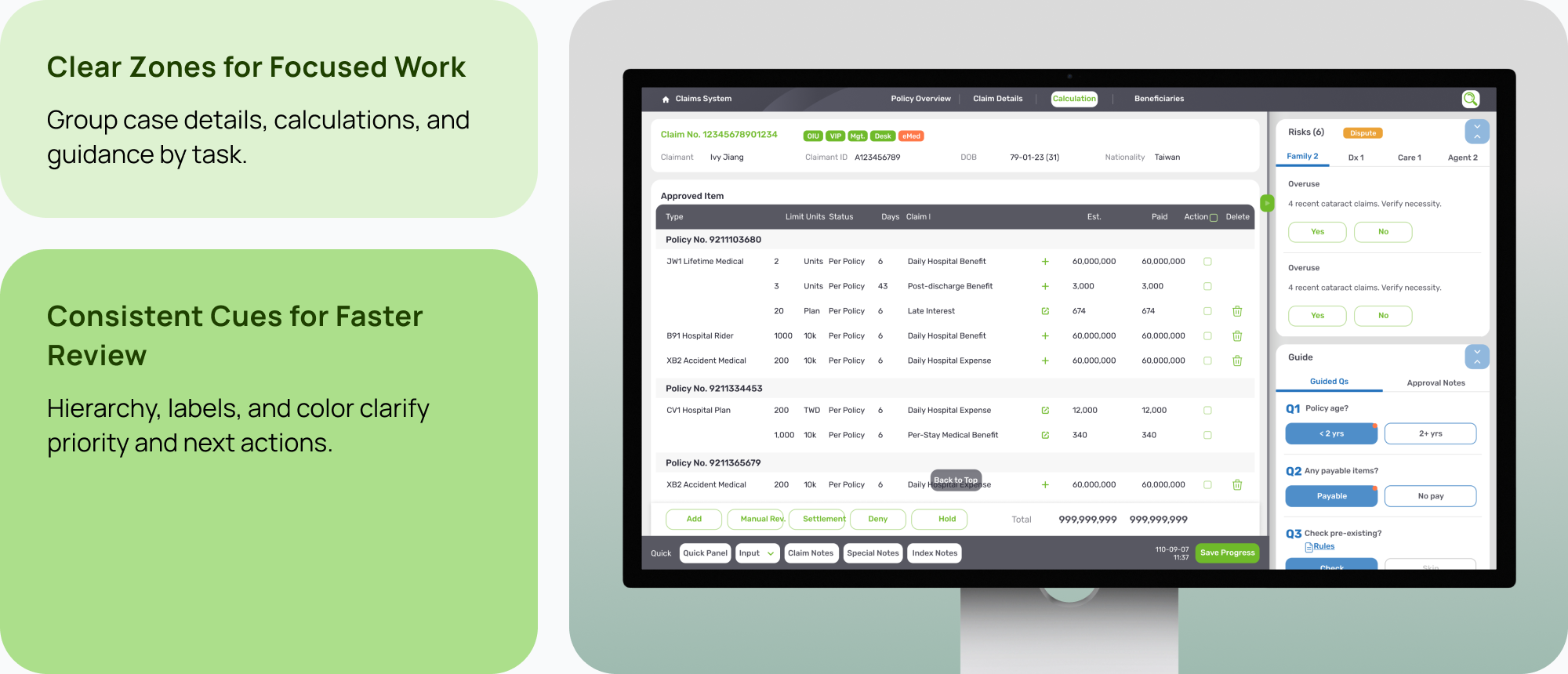
We reorganized dense claim information into a clear, consistent structure—helping reviewers quickly understand what belongs together and what to do next.

Claims information organized into clear groups for review

Workflow Optimization & Guided Actions

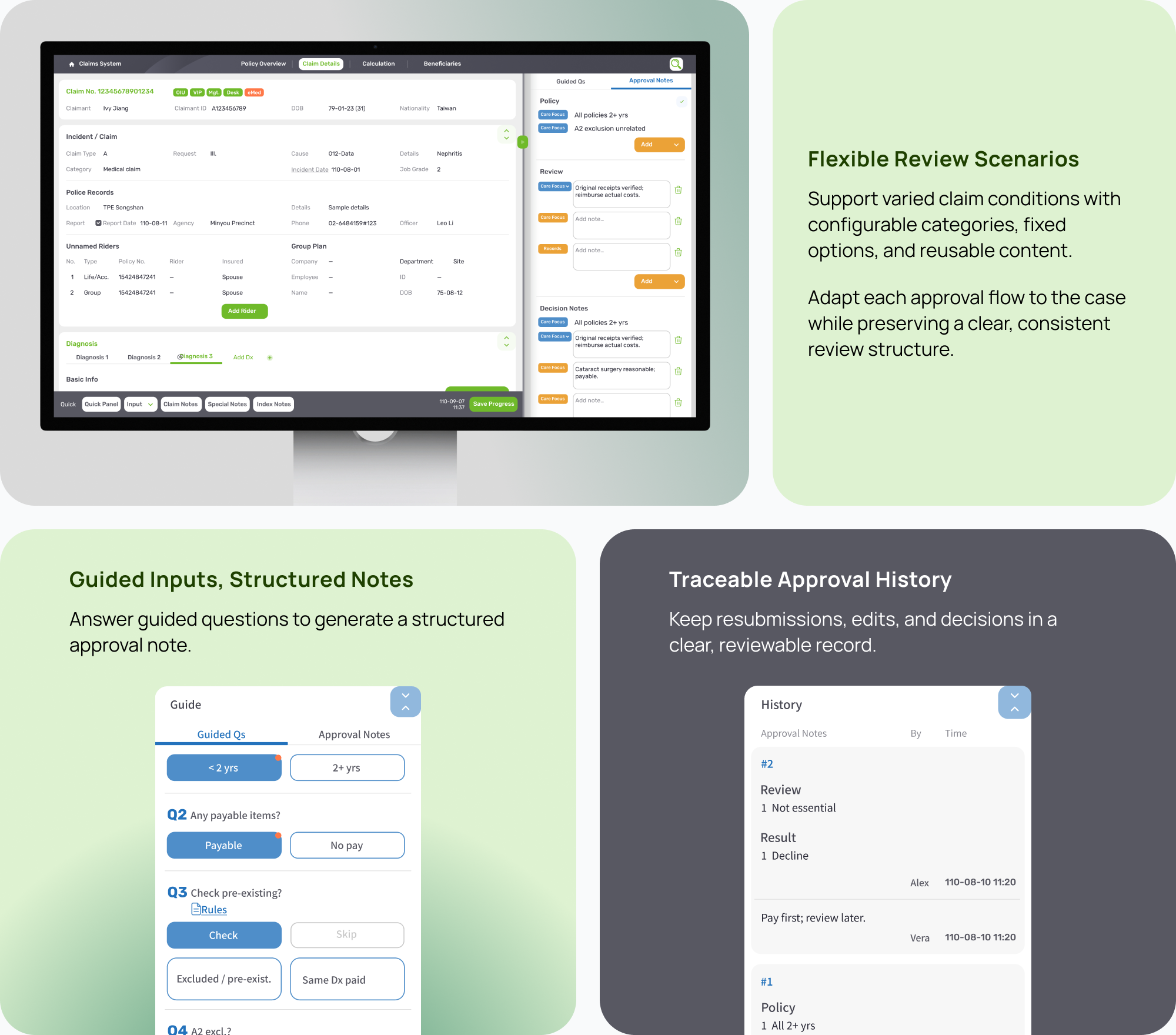
Submitting approval notes is a critical step in claim review. We replaced ad-hoc writing with a guided question flow that helps reviewers create structured approval notes faster and more consistently.

Guided questions used to create structured approval notes

Personalized Workspace

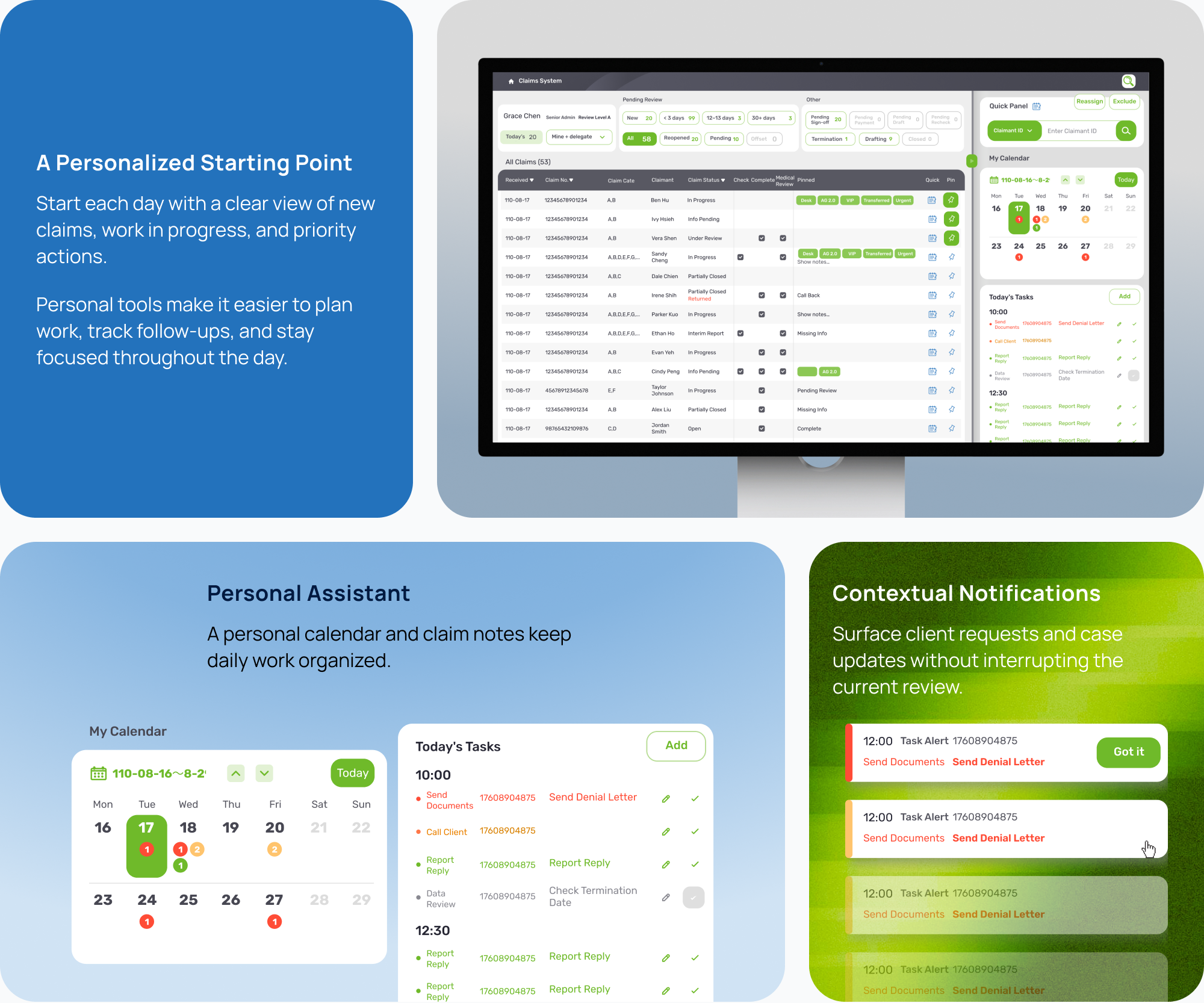
The homepage brings new claims, active work, and pending follow-ups into one place. It helps reviewers manage daily priorities, capture case notes, and respond to client requests without losing context in the case at hand.

Personalized claims workspace with calendar and case notes

UI Style

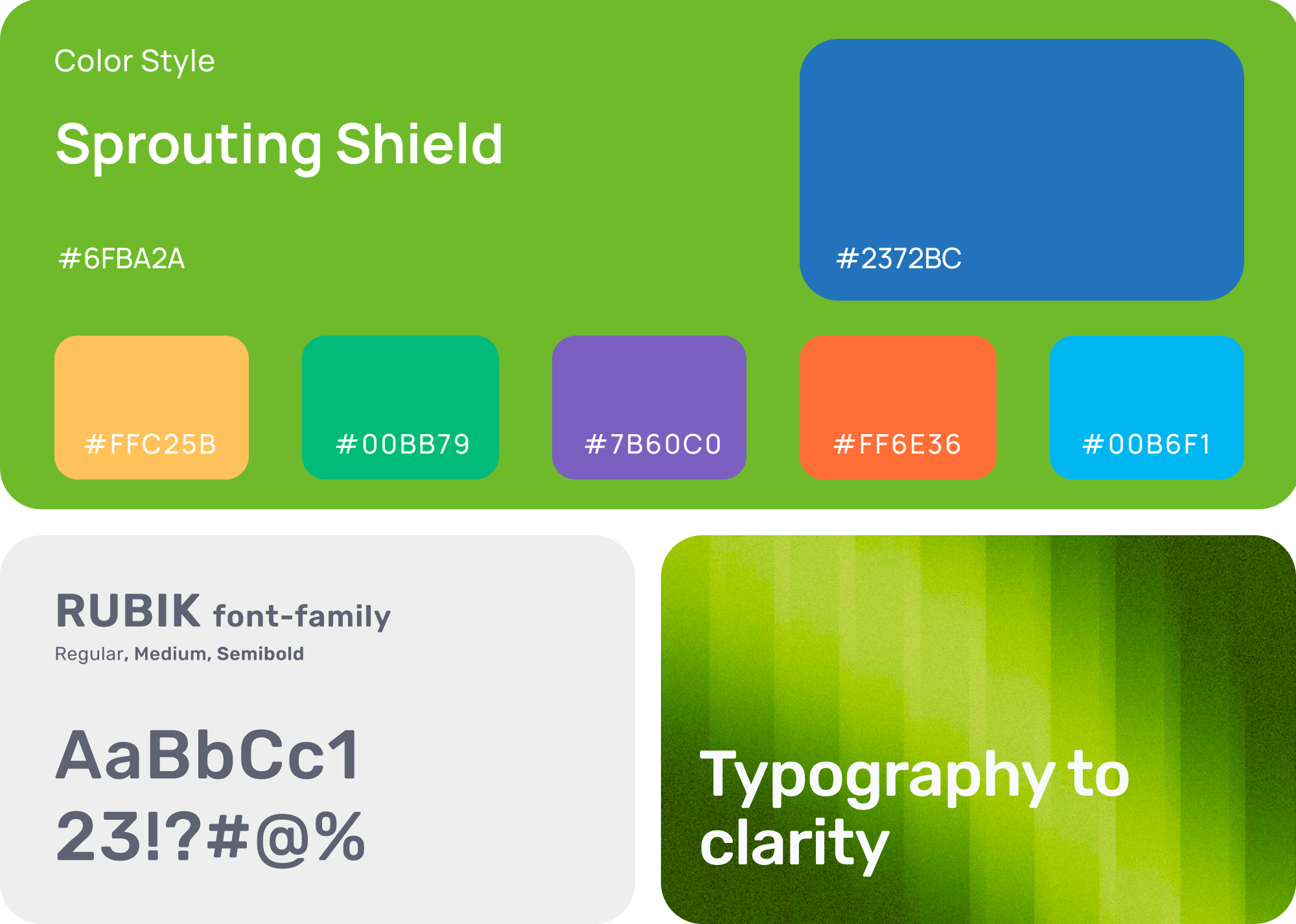
Consistent information hierarchy, field rules, and interaction states support long, high-density claims work.

Claims-system UI style and component rules
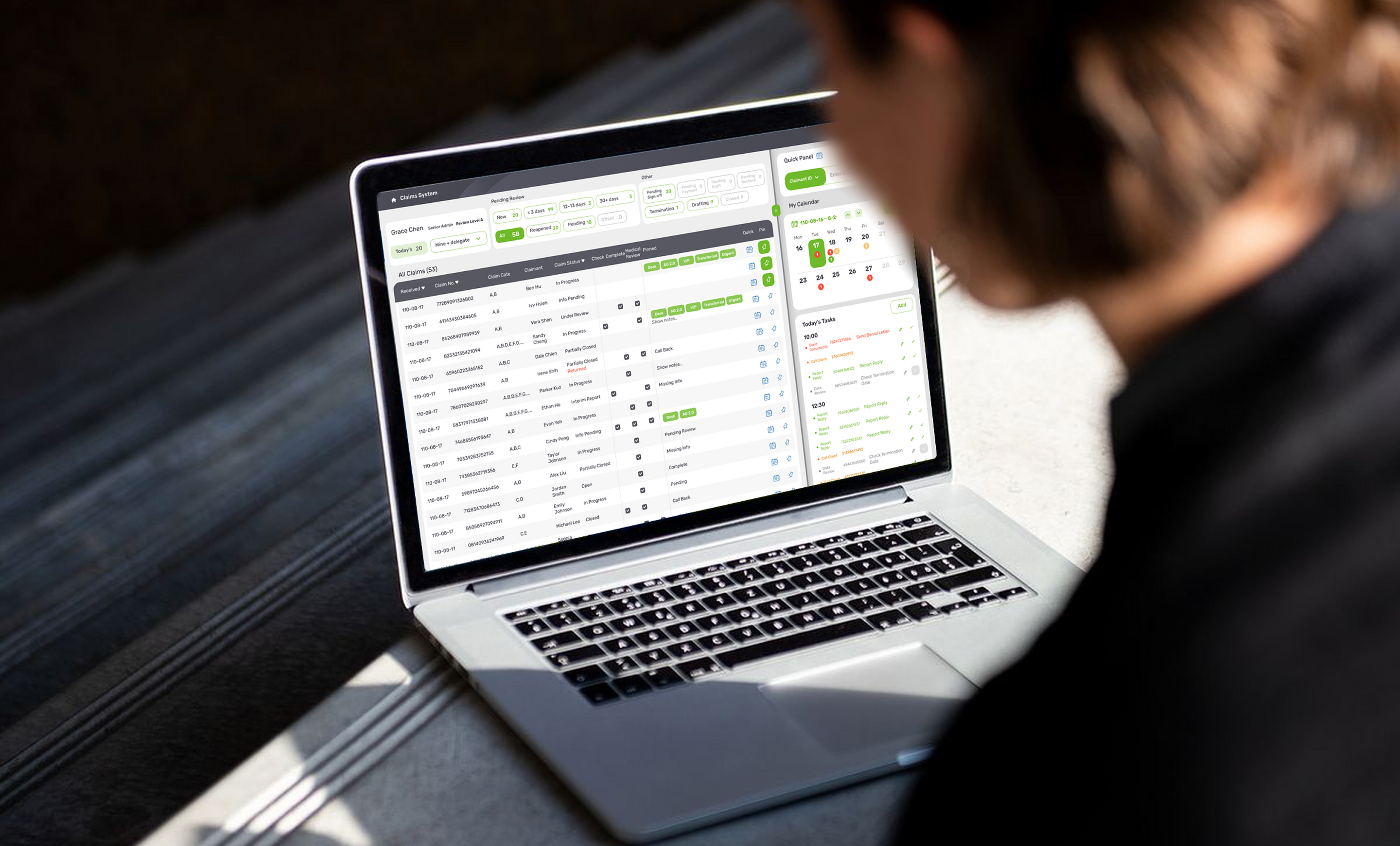
Claims work scenario

Usability Testing

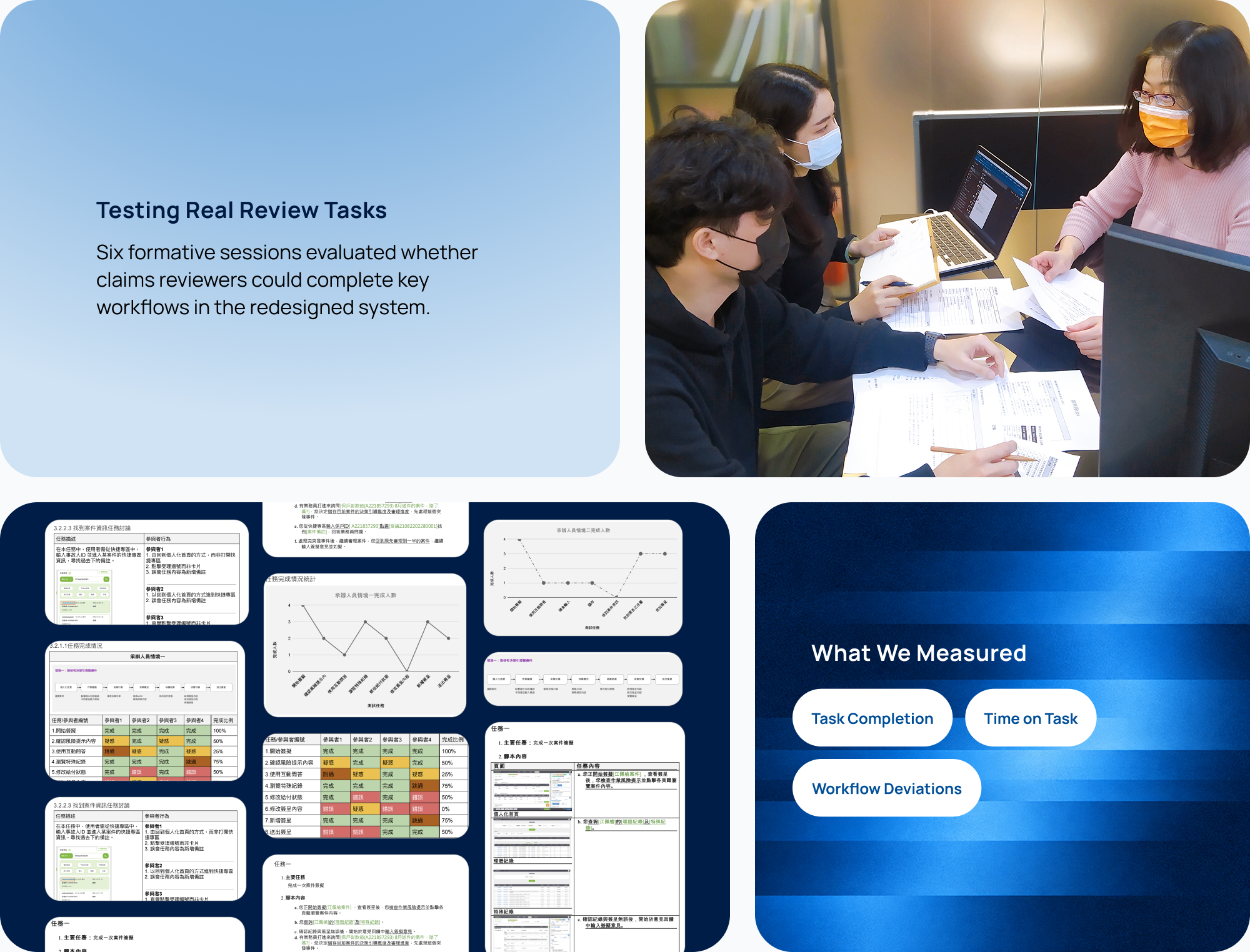
We worked with the client team to plan formative testing alongside development. Six claims specialists completed standard tasks on the development site so we could identify interaction problems before release and check whether the redesigned workflows matched their expectations.

  1. 1

    Effectiveness

    Task completion rate.

  2. 2

    Efficiency

    Estimated task time compared with actual time.

  3. 3

    Error Rate

    Compared actual task paths with the intended paths.

Given the system’s scale and varied operating contexts, the test design balanced participant stamina with research cost. As the pandemic intensified, we also prepared a remote testing option with the product team so formative feedback could continue.

We completed 6 formative usability tests on a development test site with standardized tasks. Findings and reports informed design adjustments during acceptance and environment testing.

Formative usability-testing tasks and observations

Summary

Over more than a year on the claims system redesign, I led the design planning with the PM and client, ran user interviews and usability tests, and revised the product as the team worked through requirements. Much of the work involved organizing complex source material, asking the product team for missing information, and documenting decisions clearly enough for product and engineering discussions.

When COVID-19 disrupted the original test plan, the team prepared a remote alternative and kept the research moving. The project reinforced how much an enterprise redesign depends on making rules, role handoffs, and interrupted work understandable, not only on changing the interface.

When I left the project, the system was still in acceptance and environment testing, with nationwide training planned next. This case does not claim a launch, post-release metrics, or improved outcomes.