Designing a volunteer-first mobile experience for finding opportunities, following through, and documenting verified contribution
— GLOCAL Foundation of Canada, via YouCount
Introduction
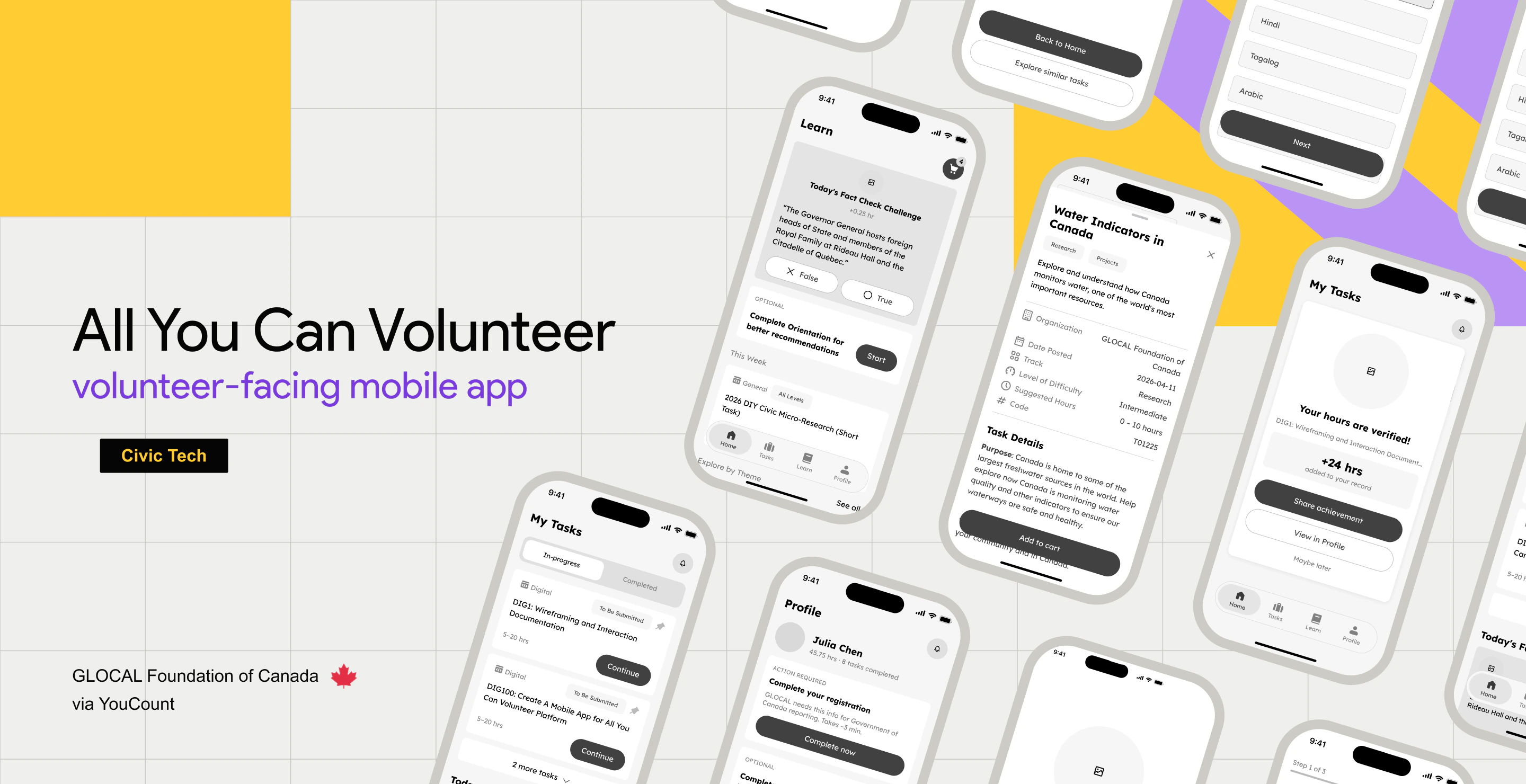
All You Can Volunteer, or AYCV, is a volunteer platform by GLOCAL Foundation of Canada. Through YouCount, I delivered three connected briefs: UX research, experience mapping, and wireframing with interaction documentation.
The work turned existing platform features into a structure for finding tasks, managing commitments, learning in context, and retaining proof of contribution. I delivered research-informed recommendations and low-fidelity interaction documentation.
Industry
Civic Tech / Nonprofit
Year
2026
Client
GLOCAL Foundation
Role
UX Researcher & Product Designer
Platform
Mobile app
Engagement
Volunteer, 64 hours
All You Can Volunteer brought task discovery, civic learning, progress, and proof of contribution into one volunteer-facing mobile experience.
Volunteer-facing mobile app | Research to interaction documentation
1Turned volunteer-sector research into a coherent direction for a volunteer-facing mobile app.
2Defined the information architecture, four core journeys, and a six-stage task-status model.
3Delivered three platform-reviewed briefs covering research, experience mapping, and interaction documentation.
The Challenge
AYCV already had useful pieces: volunteer tasks, Orientation, Fact Check content, DIY Research, hour records, certificates, announcements, and a task-submission model. The mobile challenge was deciding how those pieces should work together for volunteers.
Volunteers might not know which task fits, how much time it requires, what happens after adding it, or when submitted hours become official. Without a clear way back into unfinished work, the journey could feel disconnected.
Help volunteers find a meaningful opportunity, complete it with clear next steps, and access credible proof of their contribution.
This set a firm scope boundary. The app focused on volunteers. Organizations remained secondary stakeholders and would continue to manage tasks through a separate web backend.
From Research to Product Direction
UX Research
I reviewed Canadian volunteer-sector reports, comparable platforms, and mobile UX patterns. AI agents helped with source discovery and an early synthesis pass. I checked claims against the original reports and decided which evidence mattered to AYCV.
1
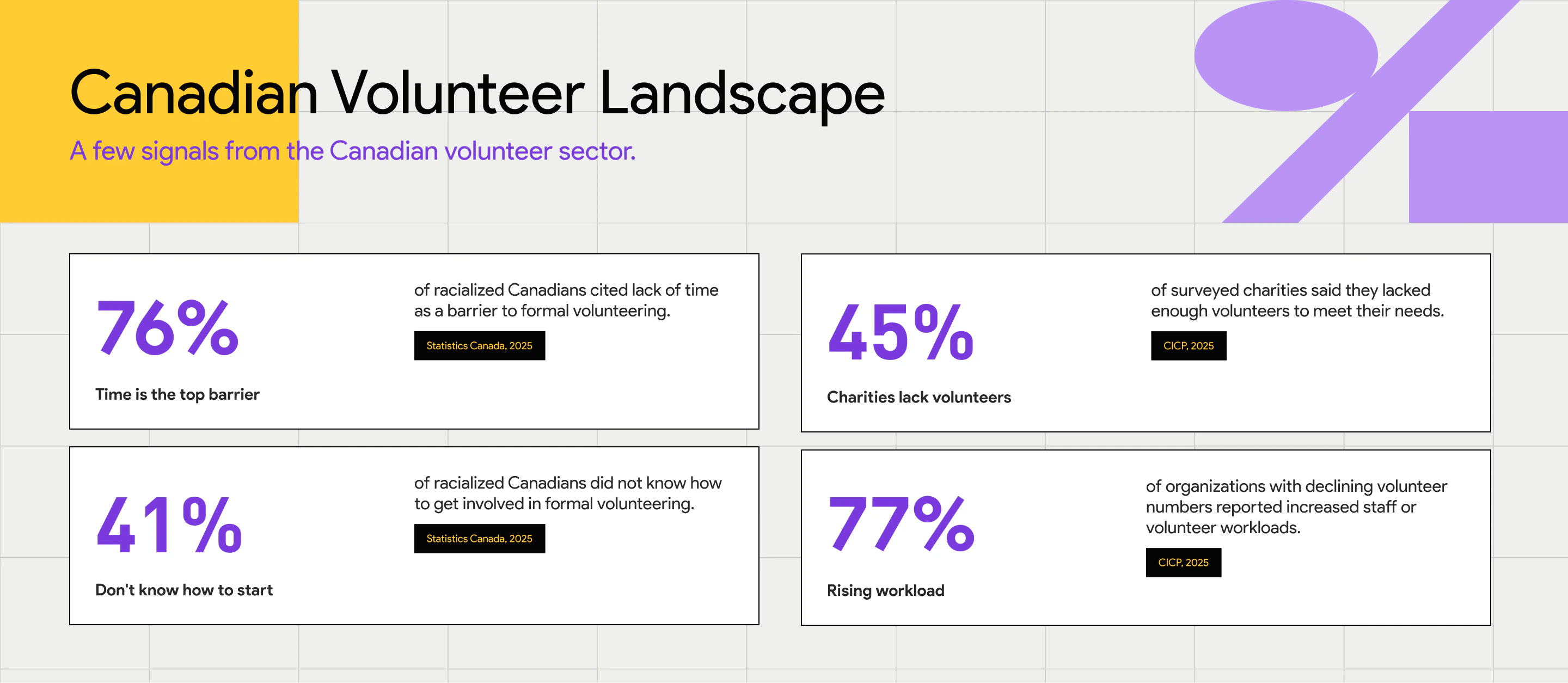
Among racialized Canadians, 76% cited a lack of time as a barrier to formal volunteering; 41% did not know how to get involved. This supported flexible opportunities, clear time expectations, and guided entry. Statistics Canada, 2025
2
45% of charities said they lacked enough volunteers. Among organizations with declining volunteer numbers, 77% reported higher workloads. This supported low-overhead follow-through on the organization side. CICP-PCPOB, 2025
Canadian volunteer-sector research framed the opportunity around clearer entry, realistic time expectations, and lower-friction follow-through.
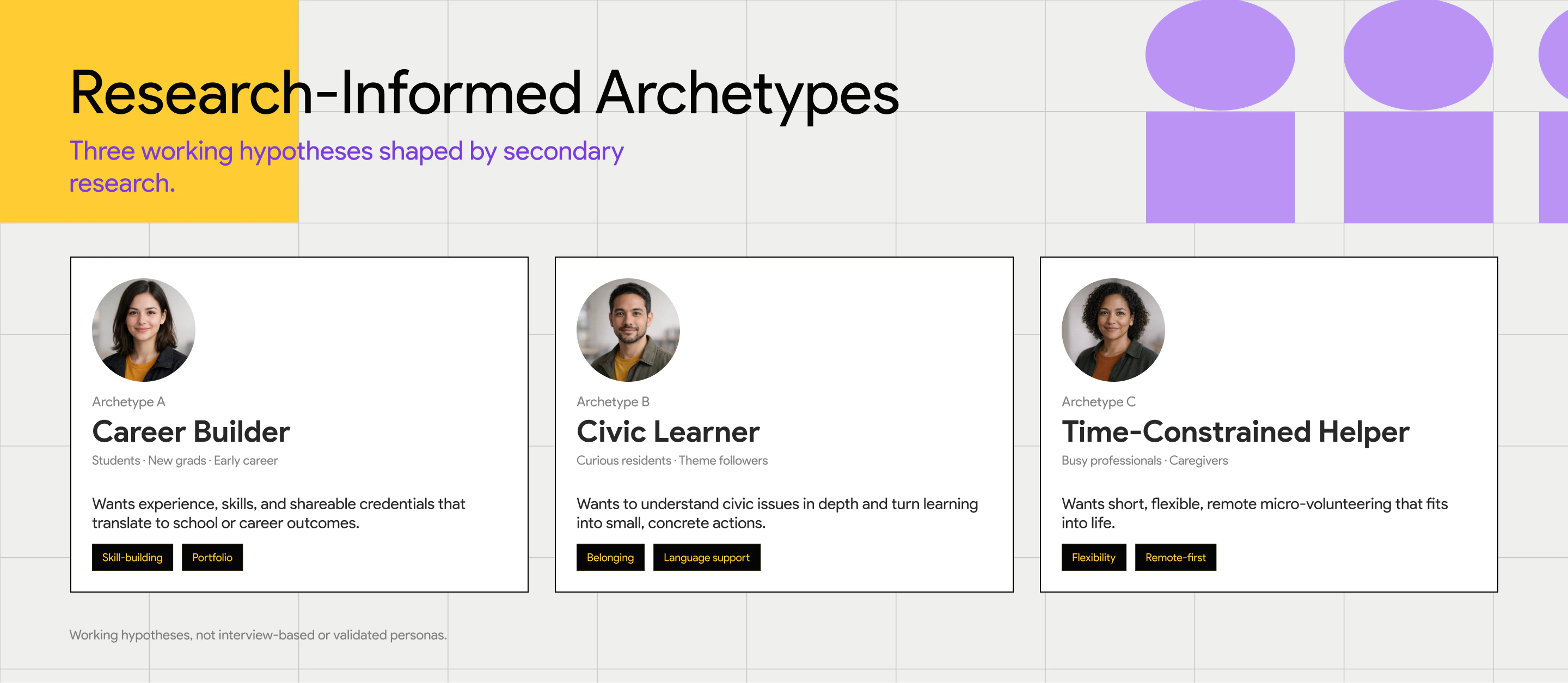
These figures provided context, not evidence about AYCV users. I combined them with three secondary-research-informed archetypes: the Career Builder, Civic Learner, and Time-Constrained Helper. Without interviews or testing, the archetypes remained working hypotheses.
Working archetypes used to translate secondary research into design considerations; they were not validated personas.
Design Structure and Experience Mapping
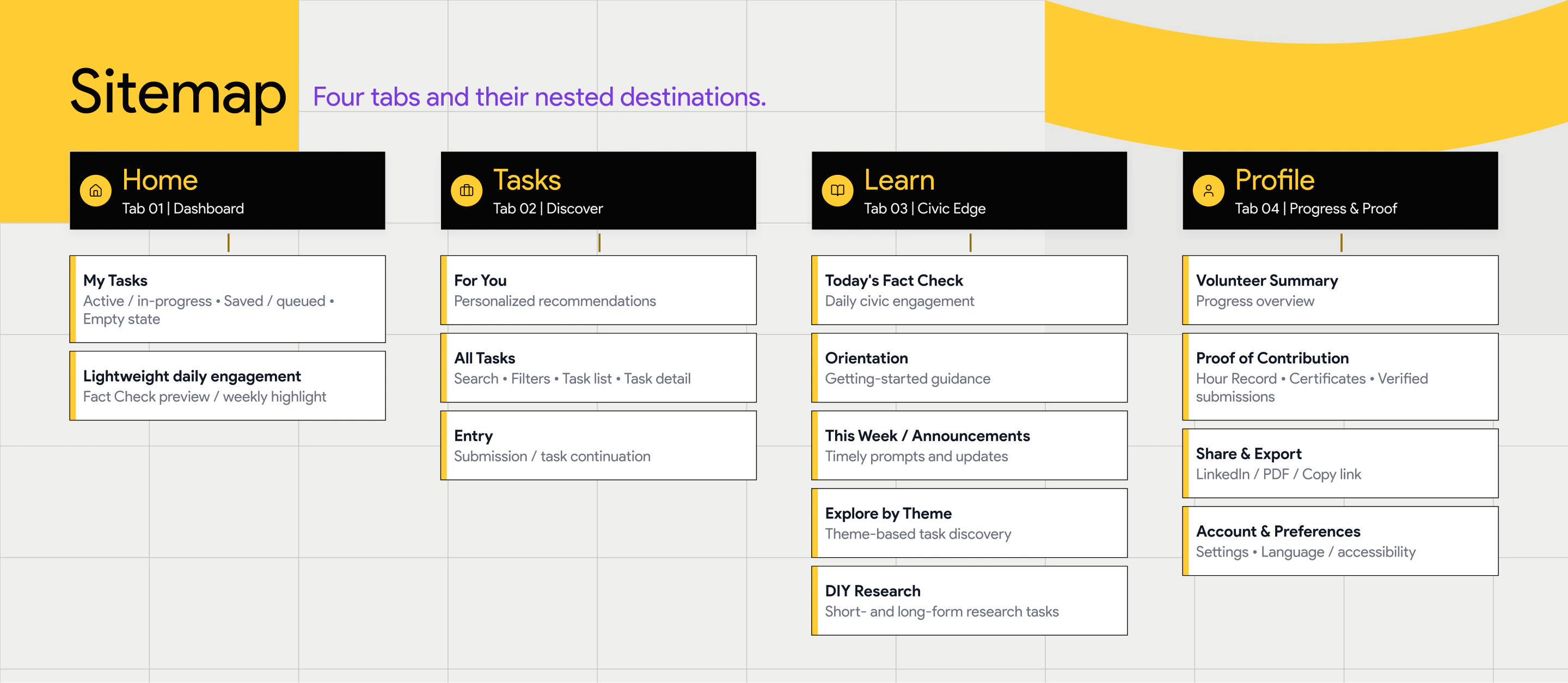
I translated the research into a four-tab sitemap, four priority flows, task breakdowns, and a shared status model before drawing detailed screens.
A four-tab structure separated active work, task discovery, civic learning, and progress records while keeping related task paths visible.The proposed status model made the difference between selecting work, doing it, submitting it, and receiving verified credit explicit.
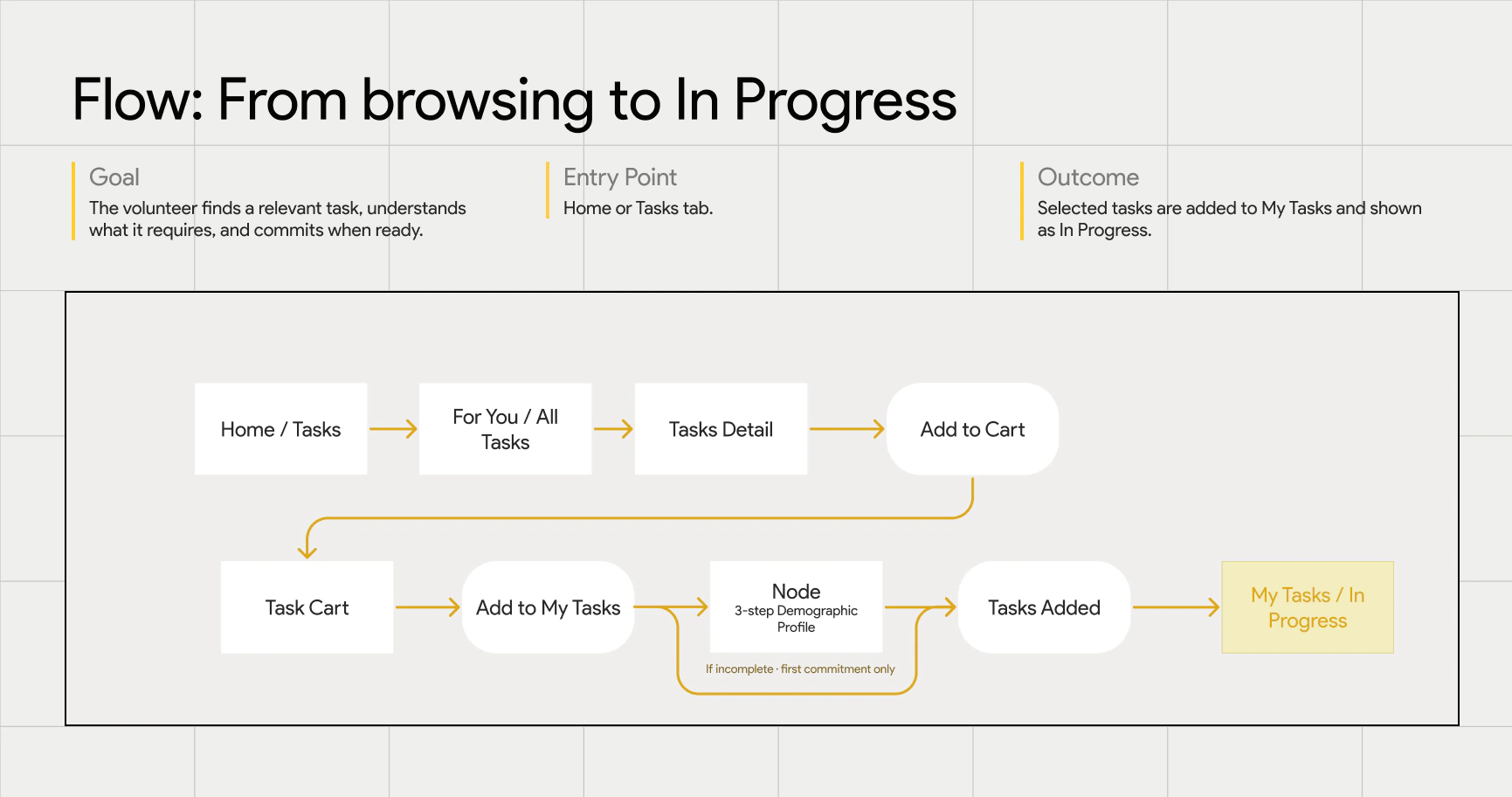
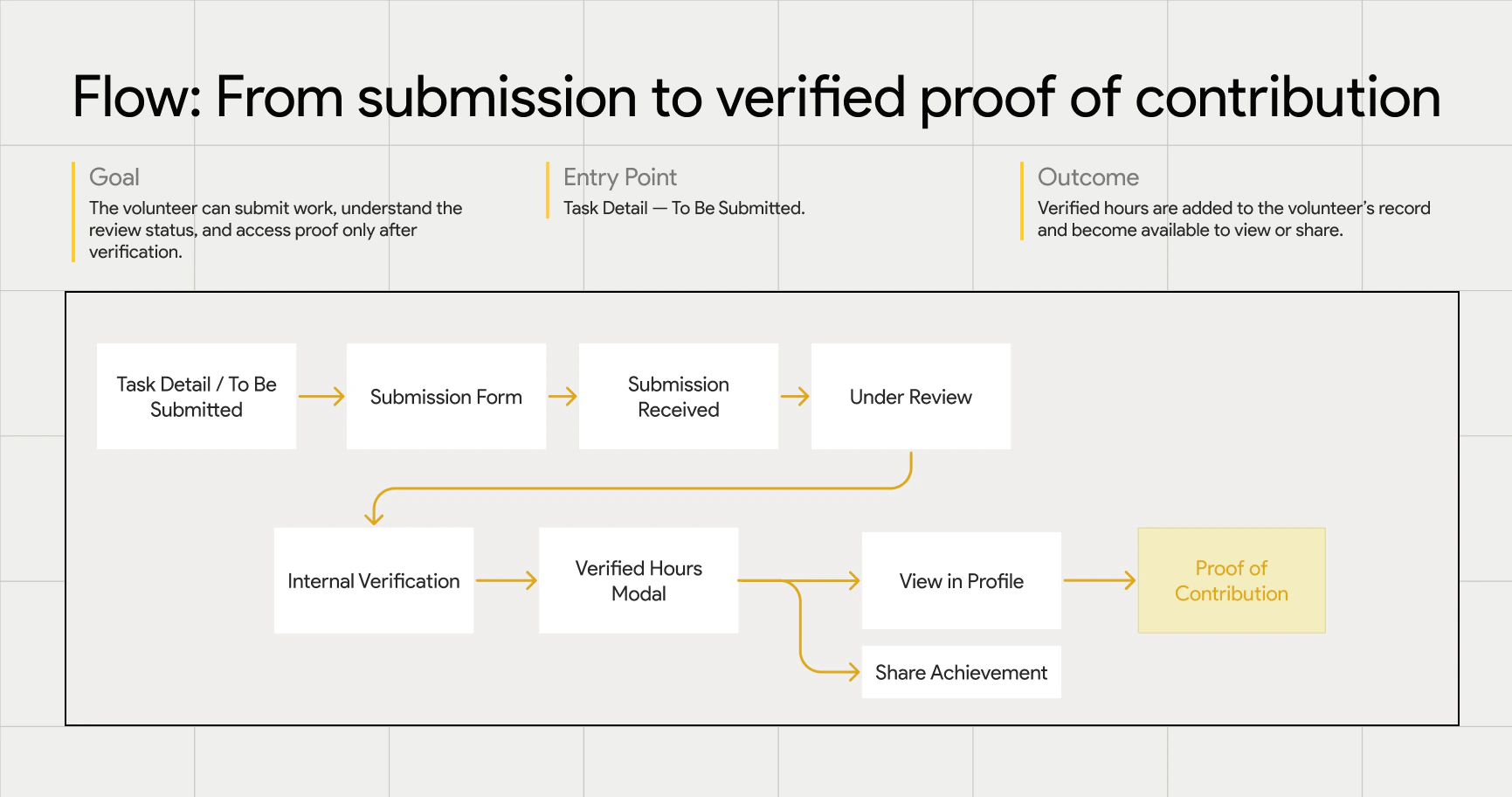
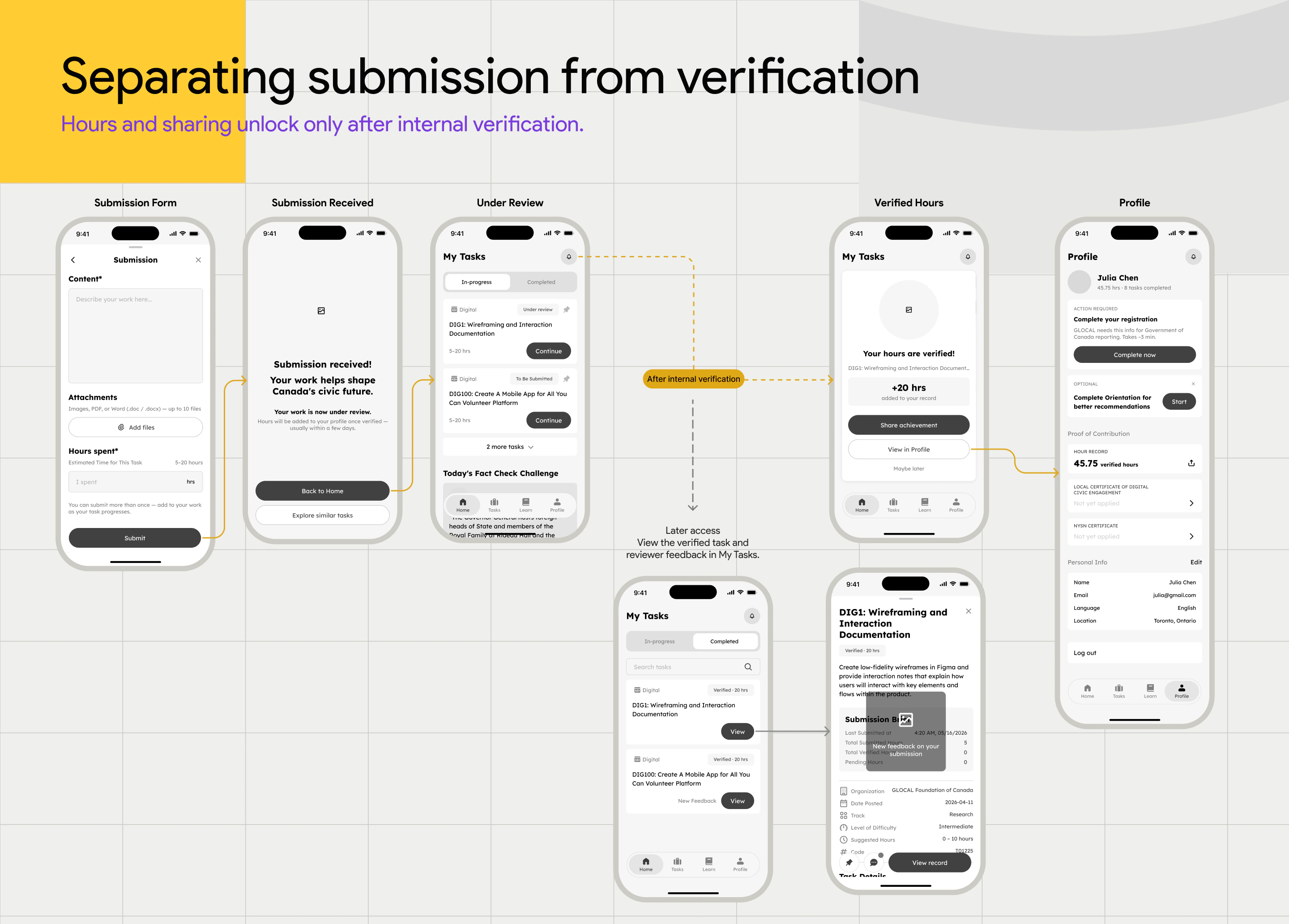
Before documenting detailed screens, I mapped the two core transitions: adding a task without overcommitting, then submitting completed work without awarding hours before review.
From browsing to In Progress: volunteers can compare and select tasks before a deliberate commitment step.From submission to verified contribution: hours and sharing unlock only after internal review.
Three Key Decisions
Separate discovery from task management
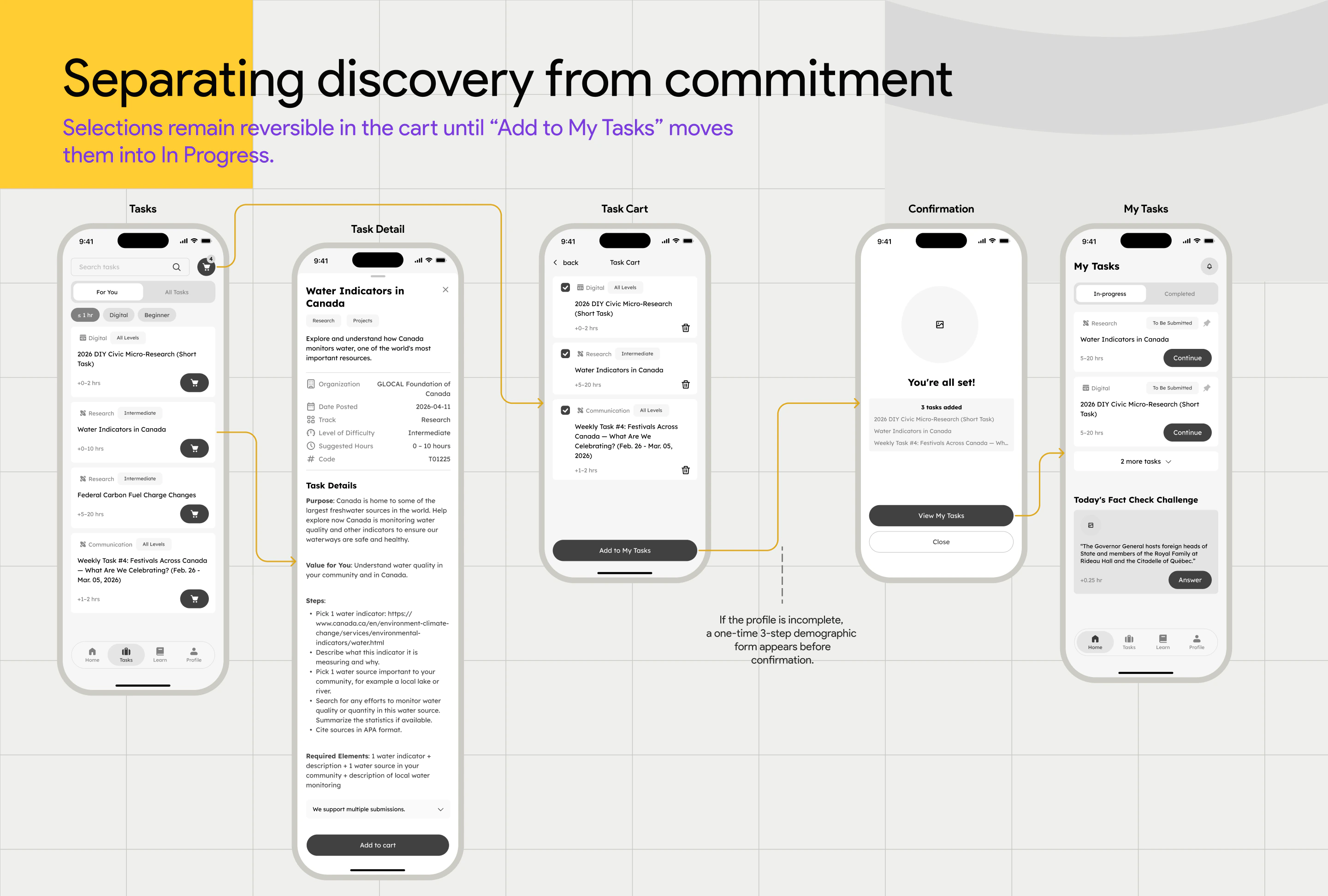
Finding a new opportunity and managing a commitment are different intents. Home holds active tasks and progress. Tasks provides a personalized For You view and searchable library. Task detail shows hours, requirements, skills, format, and the next action before commitment.
Make civic learning a path into action
AYCV’s Orientation, Fact Check, themed content, and DIY Research distinguished it from task-only platforms. I gave Learn a primary tab and connected content to optional related tasks. Learning supplied context; action remained a choice.
Keep verification visible
Submitted, Verified, and Completed stayed separate so the interface would not award recognition before review. I positioned Profile as a Progress & Proof destination for verified hours, certificates, history, and sharing tools.
Design Solution
Wireframing and Interaction Documentation
I developed low-fidelity screens and interaction notes for onboarding, task discovery, submission and verification, and learning-to-action pathways. The screens made the structure reviewable without treating unfinished rules as final.
Across the briefs, the app needed to support three connected jobs: finding a suitable task, doing the work with fewer unknowns, and sharing verified contribution.
The most distinctive flow turns finished work into usable proof. At submission, requirements remain visible beside a focused form for written work, attachments, and hours.
The confirmation states that the work is awaiting review without awarding hours early. Home carries the updated status forward, so the volunteer knows the submission landed.
Reviewer feedback appears when the volunteer returns to the task. After the proposed internal review, the task moves to Verified and approved hours become available.
In the proposed flow, sharing becomes available through a LinkedIn action, PDF or hour-record export, or a shareable link. The same proof remains in Profile alongside certificates and contribution history. The supporting flows use the same status model.
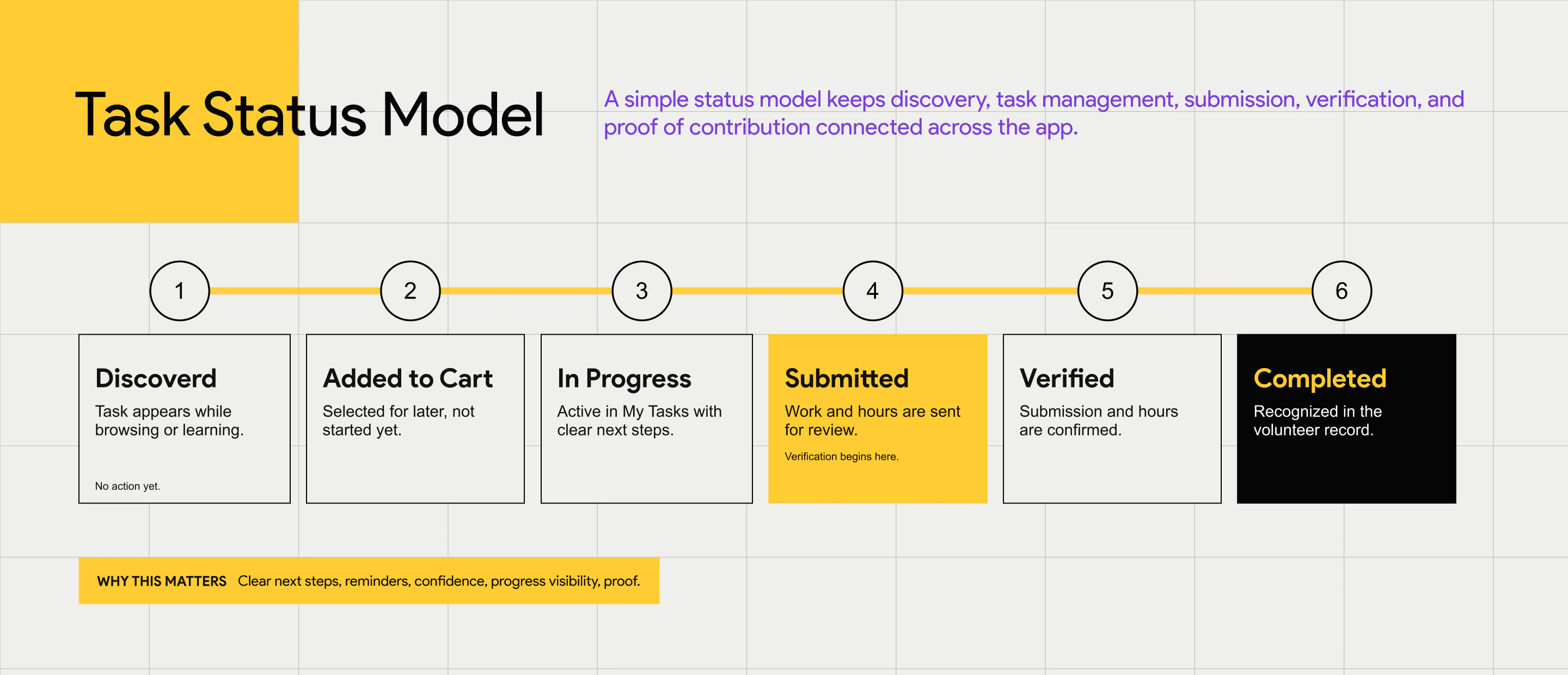
I proposed one status model across Home, task details, reminders, and Profile:
Discovered
Added to Cart
In Progress
Submitted
Verified
Completed
Separating discovery from commitment: volunteers can inspect tasks and manage a reversible cart before choosing Add to My Tasks.Separating submission from verification: submitted work remains under review until hours and sharing become available as verified contribution.
Outcome
All three deliverables were reviewed and accepted through YouCount. Together, they established a product direction, information architecture, four priority journeys, a six-stage status model, and interaction documentation.
Reviewer feedback recognized “clear, actionable UX insights,” attention to “the overall volunteer journey,” and “strong UX thinking and careful planning.”
Reflection
I was glad to contribute to a GLOCAL project through YouCount. Reviewers responded positively to the first two submissions and encouraged me to continue with related tasks. That continuity let me carry the research into experience mapping and wireframing while learning about volunteering and civic participation in a Canadian nonprofit context. It was a new domain for me, and I enjoyed turning those findings into a product direction that could be reviewed and discussed.
Context
All You Can Volunteer is a volunteer platform by GLOCAL Foundation of Canada. It already had the pieces: volunteer tasks, Orientation, Fact Check content, DIY Research, hour records, and certificates. What it did not have was a way for those pieces to work together on mobile, so a volunteer could not easily tell which task fits, how much time it takes, or when submitted hours become official. Through YouCount I delivered three connected briefs covering research, experience mapping, and interaction documentation.
Constraints
The app is for volunteers. Organizations stay secondary stakeholders and keep managing tasks through a separate web backend. There were no interviews and no usability testing, so the archetypes stayed working hypotheses and the status model stayed a proposal.
What I did
Four moves, each aimed at keeping the volunteer journey connected end to end.
Separated discovery from task management, so finding a new opportunity and managing a commitment stop competing for the same screen.
Gave civic learning a primary tab and connected content to optional related tasks, so learning leads into action without forcing it.
Kept Submitted, Verified, and Completed apart, so the interface never awards recognition before review.
Proposed one six-stage status model shared by Home, task details, reminders, and Profile.
The proposed status model gave every part of the volunteer journey the same state language.Submission remains separate from verification, so approved hours and sharing only follow internal review.
Key Design Decisions
Separate discovery from task management
Home holds active tasks and progress. Tasks holds a personalized For You view and a searchable library, with hours, requirements, and the next action visible before commitment.
Make civic learning a path into action
Learn gets a primary tab and content links to optional related tasks. Learning supplies context; acting on it stays a choice.
Keep verification visible
Submitted, Verified, and Completed stay separate, and Profile becomes a Progress & Proof destination for verified hours, certificates, and history.
Solution
Four tabs, four priority flows, and one status model shared across them. The distinctive flow turns finished work into usable proof: requirements stay visible at submission, the confirmation says the work is awaiting review rather than awarding hours early, and approved hours only appear once a reviewer has verified them.
Impact & learnings
All three deliverables were reviewed and accepted through YouCount, and reviewer feedback recognized clear, actionable UX insights and attention to the overall volunteer journey. The honest limit is that none of it was tested with volunteers: the research is secondary, the archetypes are hypotheses, and the status model is a proposal. Canadian nonprofit and civic participation was a new domain for me, and the useful part was turning unfamiliar findings into a direction someone could review and argue with.